
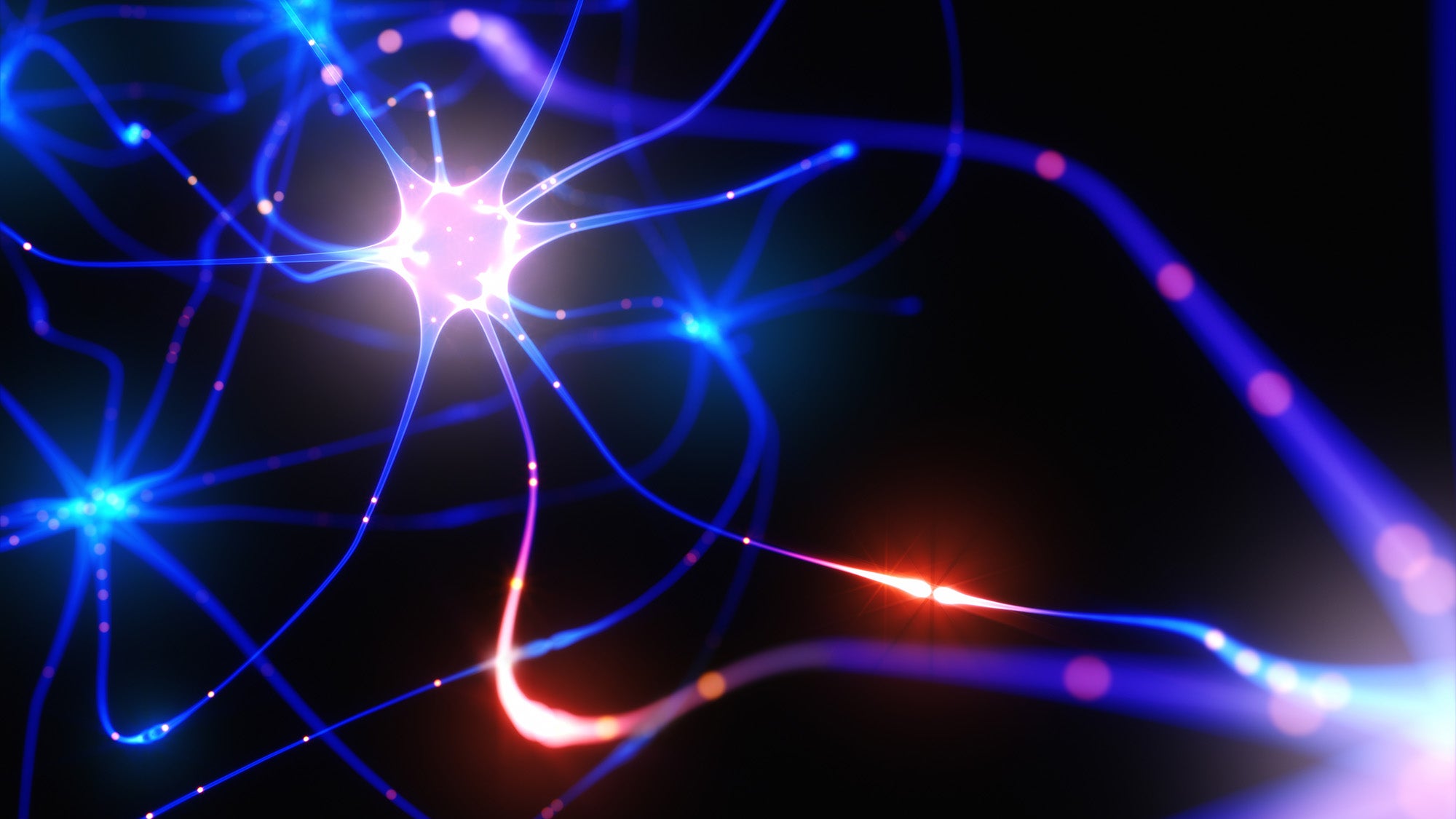
October 5, 2026 – The 2026 Nobel Prize in Physiology or Medicine was awarded Monday to American scientist Karl Deisseroth and German scientists Peter Hegemann and Georg Nagel for discoveries that led to optogenetics, a technique that allows scientists to use light to control the activity of nerve cells.
The work made it possible for researchers to investigate how specific nerve cells and circuits contribute to memories, feelings and behaviors, opening a new era in neuroscience. Deisseroth is a researcher at the Howard Hughes Medical Institute and Stanford University; Hegemann and Nagel are researchers at universities in Germany.
For Georgetown scientists, the Nobel recognition celebrates a technology that has fundamentally changed both how they study the brain and what questions they are able to ask.
“Karl Deisseroth is a gifted writer and scientist whose work reflects his motivation to better understand brain circuits that underlie mood and cognition,” said Katherine Conant, M.D., professor of neuroscience at Georgetown University Medical Center. “Along with his contributions, the tools he created have allowed many others to explore novel hypotheses.”
“The first paper from Deisseroth’s group made it immediately clear that our field was about to enter a new golden era of being able to understand how the brain works” said Patrick Forcelli, Ph.D., Jerome H. Fleisch & Marlene L. Cohen Endowed Professor of Pharmacology and chair of the Department of Pharmacology & Physiology at Georgetown University School of Medicine.
Optogenetics gives scientists the ability to selectively turn brain cells on and off with extraordinary precision, Forcelli said. He compares the change in researchers’ ability to study the brain to moving “from a ‘Rand McNally’ road atlas of the brain to something more akin to ‘Google Earth.’”
“It hasn’t just ushered in a new era,” Forcelli said. “It has fundamentally transformed our ability to understand how the brain works.”
The technology is now widely used by Georgetown researchers and is also taught to the next generation of neuroscientists. John Partridge, Ph.D., professor of pharmacology and physiology, called optogenetics “a clear game changer in the field of neuroscience,” noting that its applications are also expanding beyond electrically excitable cells.
Mark Burns, Ph.D., professor and vice chair of neuroscience, teaches optogenetics to Georgetown master’s students. For years, his lecture has included photographs of the three scientists honored Monday.
“I have been telling the students for years that a Nobel Prize was coming for this work, and I think we’re all delighted that they have finally awarded it,” Burns said. “Optogenetics changed how we understand the brain. It shows us which brain regions are wired to each other, and it lets us test what those regions actually do.”
Burns and Georgetown colleague Stefano Vicini, Ph.D., have used the technology to investigate memory loss following repeated head impacts. Their research in mice found that a memory that appeared to have been forgotten had not necessarily disappeared: The brain cells holding the memory remained, but could no longer be naturally reactivated.
“When we switched those cells on with pulses of light, the forgotten memory came back,” Burns said. “That tells us memories lost after a brain injury may be hidden rather than gone, and that we may one day be able to recover them.”
Vicini, professor emeritus of pharmacology and physiology, said the ability to activate specific neurons has been “a major step forward” for scientists trying to understand fundamental processes in the brain.
And even after years of using the technology, its underlying idea retains some wonder.
“For me,” Vicini said, “to probe brain function with light has an absolute magical and poetic feeling.”
Read More
More BGE NewsFaculty, News
Nobel Prize Honors Discovery that Transformed Neuroscience at Georgetown and Beyond
Georgetown faculty researchers speak about optogenetics, a technique that has “fundamentally transformed our ability to understand how the brain works” by using light to control the activity of nerve cells.
October 6, 2026
Alumni Profiles, BGE Pulse, News
BGE Pulse Podcast: Gareth Francis (G’26), Tumor Biology Alumnus and Biology Ph.D. Student
On this episode of BGE Pulse, Gareth Francis (G’26) retraces his journey into biological research, starting with undergraduate lab work in host-microbe symbioses and through by his time in Georgetown’s M.S. in Tumor Biology Program. Gareth talks about the evolution of his drive to make an impact through science, his interest in science communications, and the current stage of his career as a Biology Ph.D. student.
October 2, 2026
News, Postdocs
National Postdoc Appreciation Week 2026: Resources and Recognition for Georgetown Postdocs
During National Postdoc Appreciation Week, we highlight Georgetown postdoctoral associates’ impact on the broader university community. Read on to find postdoc resources from Georgetown and the National Postdoctoral Association, and messages of gratitude from BGE Ph.D. students to postdocs.
September 25, 2026