

The dynamic M.S. in Epidemiology curriculum prepares you for impactful work in epidemiology and emphasizes health equity and the role of community-based research. Our core courses cover fundamentals in epidemiology and health disparities, and provide scientifically grounded training in theory, policy and research. You can choose one of three specialized areas for your concentration and thesis focus.
Application
Undergraduate students in the College of Arts & Sciences who meet the master’s program admission requirements are eligible to apply to this accelerated program by July 1 after their junior year. Students who wish to apply should inquire with their undergraduate advising dean and the director of the M.S. in Epidemiology program.
For more information about our program and admissions, please contact us.
Timeline
Undergraduates start taking master’s courses in their senior year, earning the master’s degree one year after completing their bachelor’s degree. (The standard M.S. in Epidemiology takes two years.)
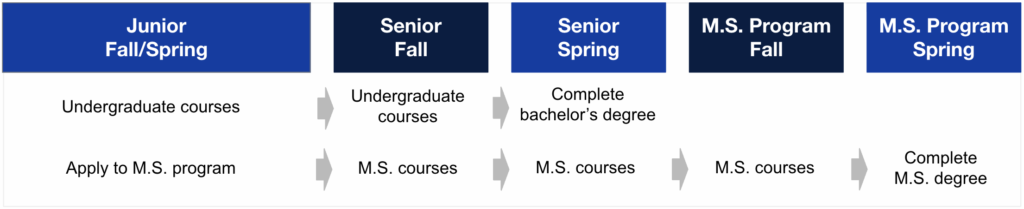
Note: Some programs will have different distributions of undergraduate and master’s courses to accommodate schedule conflicts.
Example Degree Plan
The accelerated degree program requires you to complete the 120 credits required to earn a Georgetown undergraduate degree and 34 credits for the M.S. in Epidemiology, with no break in between. You will begin taking M.S. credits during your senior year; you can count up to 6 credits for both your bachelor’s and M.S. degrees. After finishing your bachelor’s degree, you will take the two more semesters of courses for your master’s degree.
Students in the accelerated bachelor’s/M.S. program typically follow the below schedule.
Senior – Fall
| Course Name | Graduate Credit(s) |
|---|---|
| Undergraduate courses | — |
| EPID 5001 Epidemiology I: Principles of Epidemiology OR EPID 5003 Biostatistics I: Introductory Biostatistics | 3 |
| EPID 7949 EPID Independent Study | 3 |
| 6 Graduate Credits |
Senior – Spring
| Course Name | Credit(s) |
|---|---|
| Undergraduate courses | — |
| EPID 5002 Epidemiology II: Advanced Methods in Epidemiology (3 Credits) OR EPID 5005 Biostatistics II: Applied Biostatistics (3 Credits) AND EPID 5006 Computer Software Lab II (1 Credit) | 3-4 |
| EPID 7949: EPID Independent Study (3 credits if taking EPID 5002; 2 credits if taking EPID 5005 and 5006) | 2-3 |
| 6 Graduate Credits |
- Note: Full-time undergraduate status requires a minimum of 12 total credits. Graduate credits count toward this total.
- Upon completion of your undergraduate degree requirements, you will receive your bachelor’s degree and may participate in Commencement with your undergraduate class. Contact your advising dean for more information.
Master’s – Fall
Complete the Biomedical Graduate Education Orientation at the start of the semester.
| Course Name | Graduate Credit(s) |
|---|---|
| EPID 5003 Biostatistics I: Introductory Biostatistics OR EPID 5001 Epidemiology I: Principles of Epidemiology | 3 |
| EPID 5007 Introduction to Social and Behavioral Health & Health Disparities Research | 3 |
| EPID 5010 Research Ethics & Professional Development Seminar | 1 |
| EPID 9999 Thesis Research | 0 |
| Elective(s) | 4 |
| 11 Graduate Credits |
Students pay the per-credit rate.
Master’s – Spring
| Course Name | Graduate Credit(s) |
|---|---|
| EPID 5005 Biostatistics II: Applied Biostatistics (3 Credits) AND EPID 5006 Computer Software Lab II (1 Credit) OR EPID 5002 Epidemiology II: Advanced Methods in Epidemiology (3 Credits) | 3-4 |
| EPID 5008 Introduction to Cancer Epidemiology | 1.5 |
| EPID 5009 Introduction to Infectious Disease Epidemiology | 1.5 |
| EPID 5011 Research Ethics & Professional Development Seminar | 1 |
| EPID 9999 Thesis Research | 0 |
| Elective(s) (4 credits if taking EPID 5002; 3 credits if taking EPID 5005 and 5006) | 3-4 |
| 11 Graduate Credits |
- Students pay the per-credit rate.
- Follow the Biomedical Graduate Education Graduating Student Checklist to apply for graduation and to register for Commencement.
Master’s Courses
Visit M.S. in Epidemiology Courses to browse our required and elective courses.
Accelerated Programs FAQ
Answers to questions about the accelerated program.