
Research ‘Breaks Out’: Operation Outbreak Simulation Opens New Paths for Georgetown Students
By Benjamin Nochimson
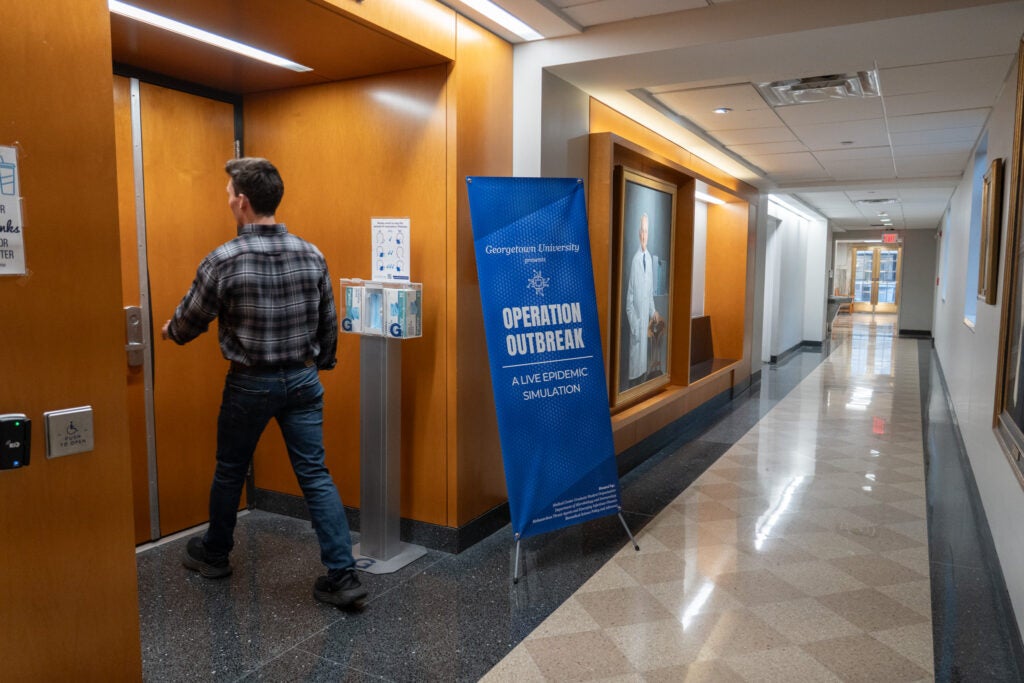
A student walks into the Harvey Amphitheater as the simulation begins. Photo courtesy of Operation Outbreak
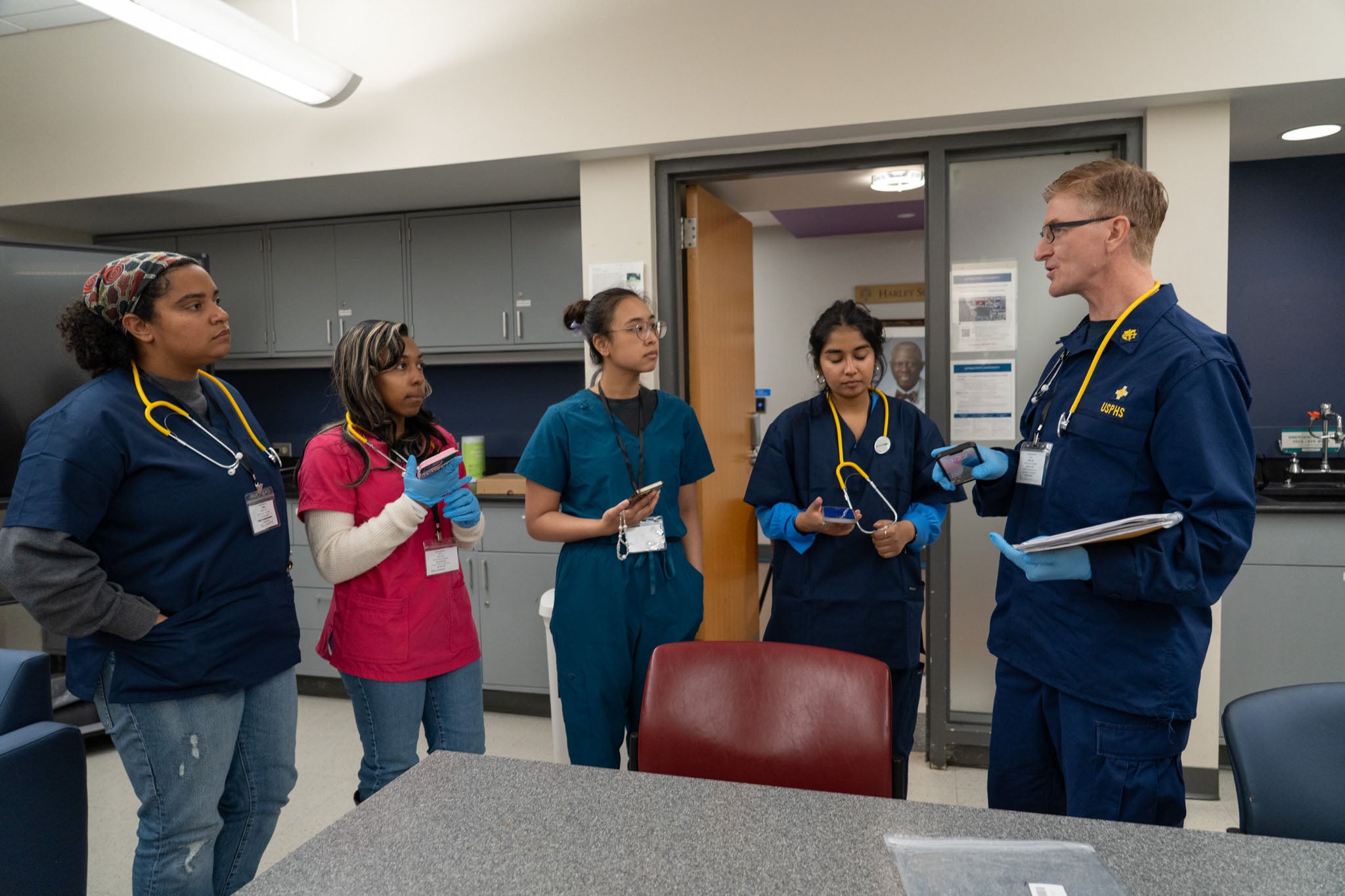
In the afternoon on Friday, March 27, Georgetown University’s Medical and Dental Building turned into a site of organized chaos as an unknown infection struck. Dozens of people hustled through the hallways, trying to earn enough money to buy food and stay healthy. Public health staffers tried their best to execute their roles, some with little prior experience, the atmosphere creating a trial by fire. Government instructions were scant, and media reports were often conflicting. It was a palpable frenzy of activity and cooperation.
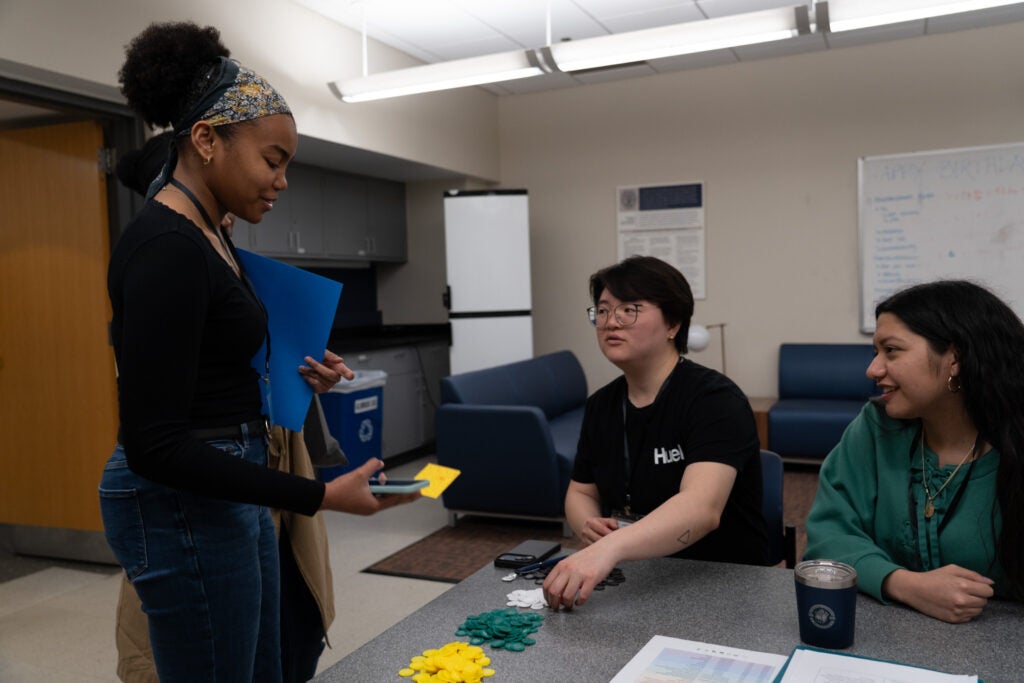
One participant exchanges stamps of tasks completed for money at the bank. Photo courtesy of Operation Outbreak
Of course, none of what happened was real. This was all part of Operation Outbreak, a simulation of a measles-like virus, spearheaded by M.S. in Biohazardous Threat Agents & Emerging Infectious Diseases (Biohaz, BHTA) student Curtis Hoffmann. Operation Outbreak participants use a mobile app that spreads a Bluetooth-borne virtual pathogen based on proximity.
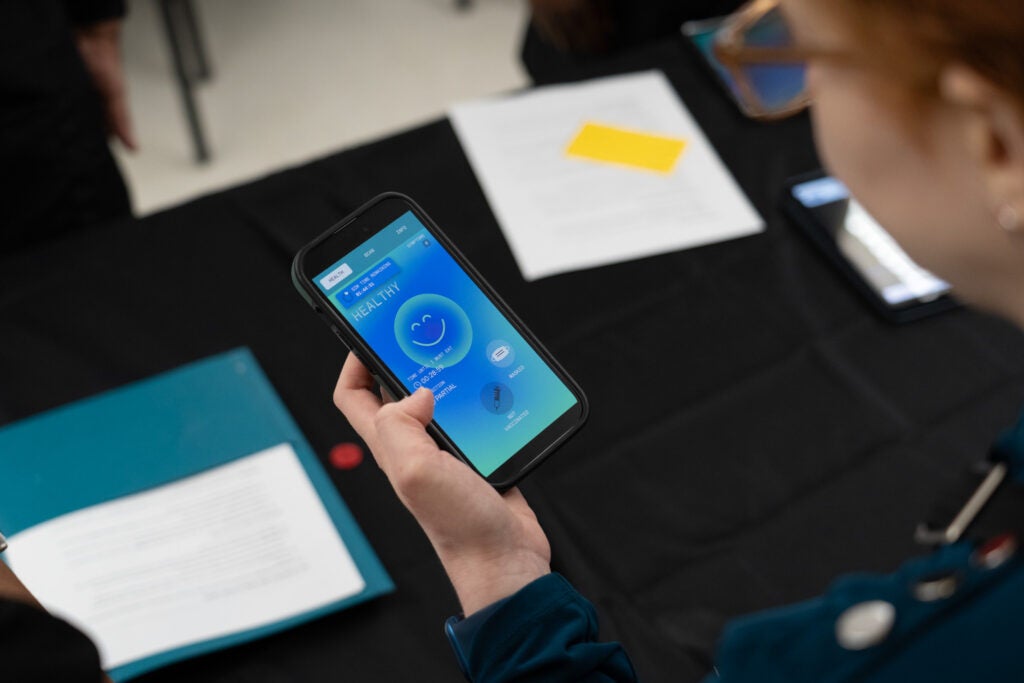
Simulation participant Shayna Korol (G’25) checks her health status on the Outbreak app. Photo courtesy of Operation Outbreak
Hoffmann got involved with Operation Outbreak after getting firsthand experience in emergency response to disease. Hoffmann was a volunteer in Thailand when the COVID-19 pandemic struck the country in January 2020 – the first reported case of transmission outside of China. He and fellow volunteers quarantined for weeks before being sent home to Utah, where pandemic panic was setting in.
“You couldn’t have a much starker contrast from a cultural perspective in how [Thailand and the United States] responded to an emerging infectious disease,” Hoffmann said. “[In] Thailand, we’re running out of masks. [In the] United States, we’re running out of toilet paper, right? We focused on very different things, and we saw a lot of division, divisiveness, discord occur.”
Hoffmann looked for ways to use his microbiology knowledge to teach his community about science and health literacy. That’s when he found Operation Outbreak. The organization had its inception in 2015 as a joint initiative between a middle school civics teacher and a Harvard infectious disease researcher who wanted to come up with a more engaging way to teach students about outbreaks like the then-ongoing Ebola outbreak. The project developed its smartphone app to simulate disease spread, and years before the COVID pandemic, educators and students were running simulations and discovering some of the challenges that would begin to play out in the real world in 2020. Hoffmann took an internship with Operation Outbreak, and today, he is the organization’s biosecurity education lead, holding biosecurity workshops supporting student ambassadors.
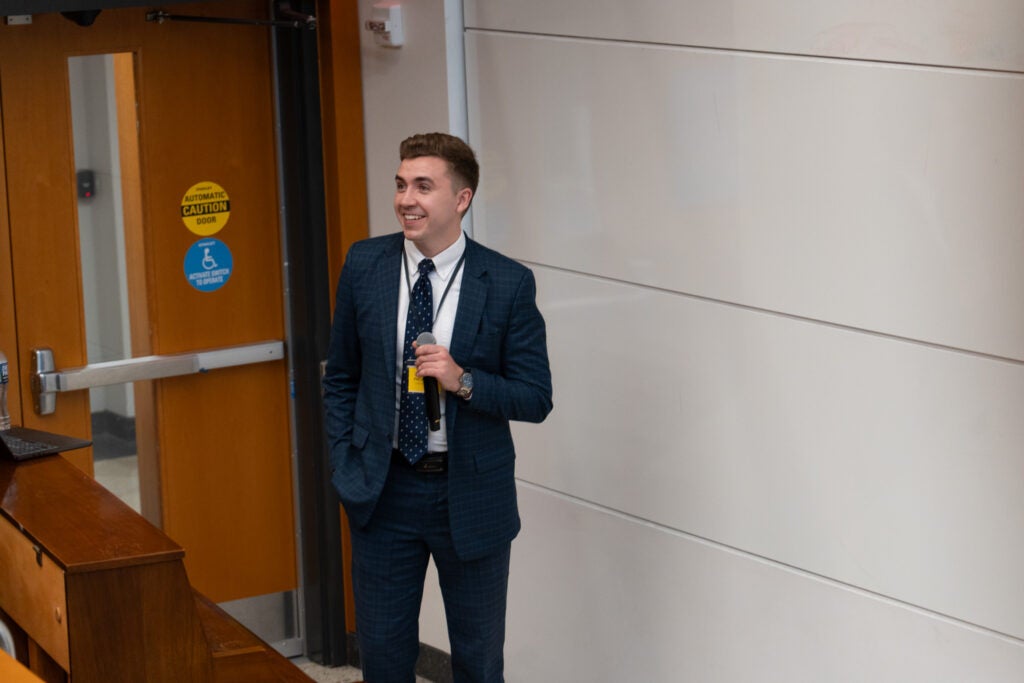
Curtis Hoffmann speaks to participants before the simulation. Photo courtesy of Operation Outbreak
In addition to the outbreak simulation, the full day of activities at Georgetown included distinguished speakers in biosecurity, disaster management, medical humanities, and defense, who brought to life the multidisciplinary nature of outbreak science, as well as student speakers presenting their research in the morning. Speakers included Elizabeth Cameron, senior advisor at the Brown University Pandemic Center; Chad M. Gorman, president and CEO of Gravitas Strategies consulting practice; Emily Mendenhall, Director of Science, Technology, and International Affairs at Georgetown’s Walsh School of Foreign Service; and Michael Koeris, director of the Biological Technologies Office at the Defense Advanced Research Projects Agency (DARPA). Student speakers included Biohaz students Albert Rehmann and Esha Mishra as well as Prudence Lindbergh, a student in the M.S. in Epidemiology program.
Lindbergh presented her research on immunity durability in viruses, as well as serving as the research and data manager for the Georgetown outbreak simulation.
“My interest is specifically in infectious disease modeling, outbreak modeling, and outbreak cluster mapping, so this is very relevant,” said Lindbergh. “I think that the collaboration was really on par with what I expected because I wasn’t sure if people were going to stay in their individual work units or not. Ideally, they would all communicate with each other, and I think that’s what happened.”
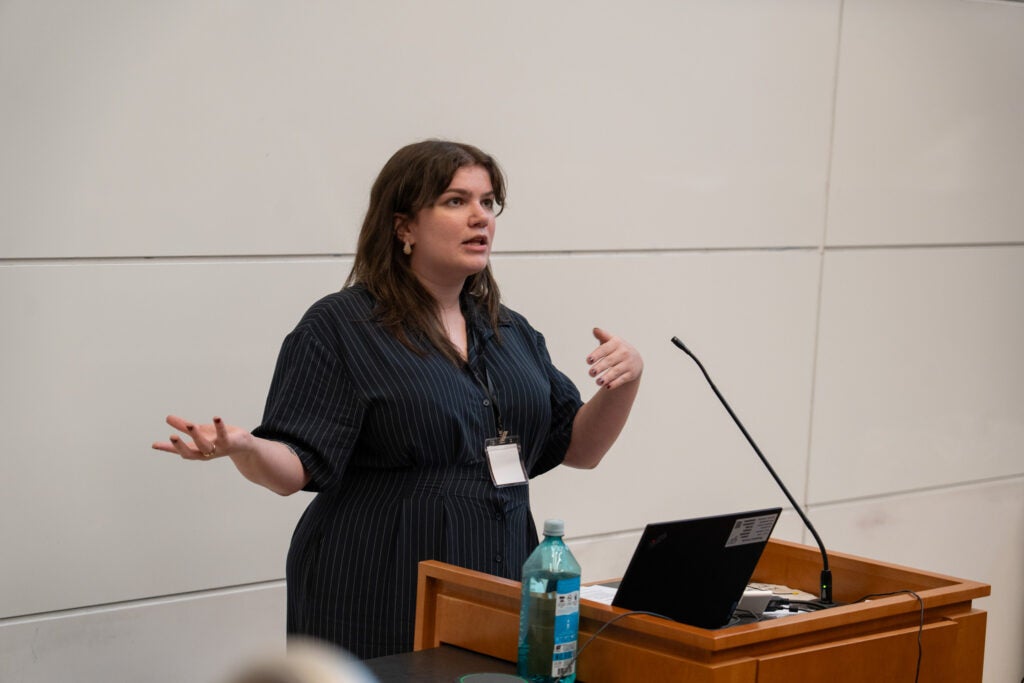
Epidemiology student Prudence Lindbergh presents her research. Photo courtesy of Operation Outbreak
Participants met the simulated disease outbreak with collaboration and camaraderie. Participants from across the university were assigned roles ranging from general population to health professionals, media and governmental agencies, and they took their roles seriously – even when that role was to be a rabble-rouser! Still, cooperation won out in the end.
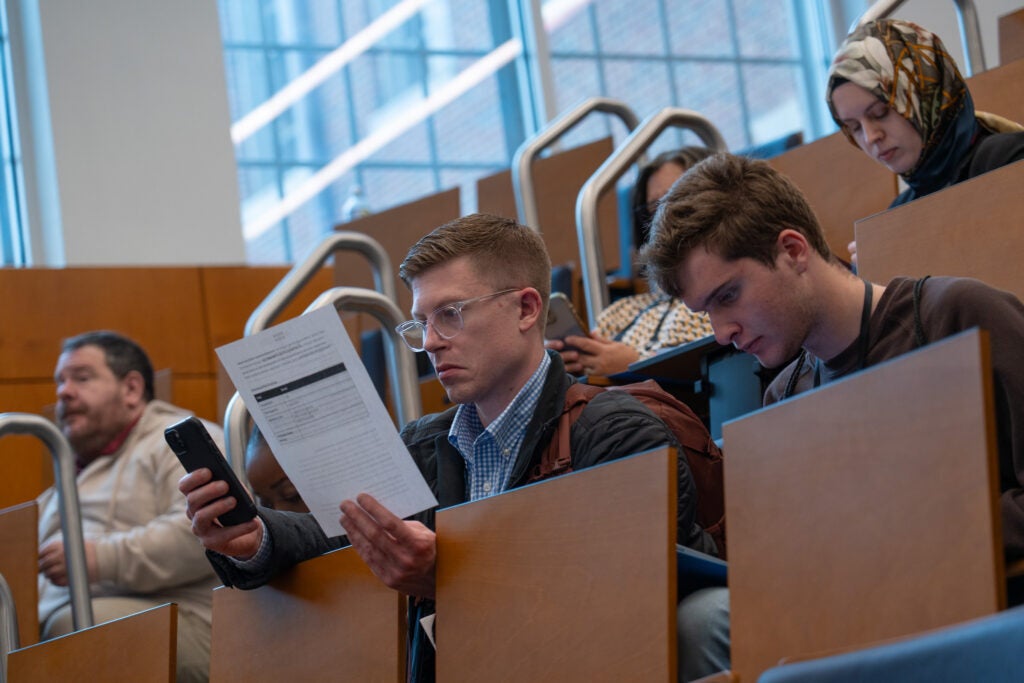
Participants check their assignments and their phones to determine their roles in the simulation. Photo courtesy of Operation Outbreak
Biohaz student Sage Tawfeeq served as a field observer and facilitator for the simulation. Tawfeeq heralded the day as a success: “I heard a lot of good feedback. Everybody said they had a lot of fun. I know personally, I learned a lot … and it was really fun to see people learning about what it means to be in these roles when you have all this stress on you of keeping yourself and many, many other people safe and keeping things functioning and afloat.”
Georgetown Law student Omer Sharon was assigned to be part of a low-income household with a lot of trust in the government, which proved significant once vaccines were released, as his family heeded governmental advice to take the vaccine. Despite the challenges of having to continue work when his partner got sick, Sharon enjoyed the experience: “I had tons of fun. I saw [the event] in the law school’s WhatsApp group, and I said ‘Sure, why not,’ and I’m really glad that I came.”
Shayna Korol (G’25), a Biohaz alumna and reporting fellow at Vox, said: “It was helpful to assign people different roles and different socioeconomic statuses. … A lot of outbreak simulations don’t take that into account.”
Said Connor Tyrone, a freshman in McDonough School of Business: “I like how [the simulation] brought together people of diverse backgrounds from all different grade levels, ages, schools within Georgetown, or outside of that to come together and do an experiment.”
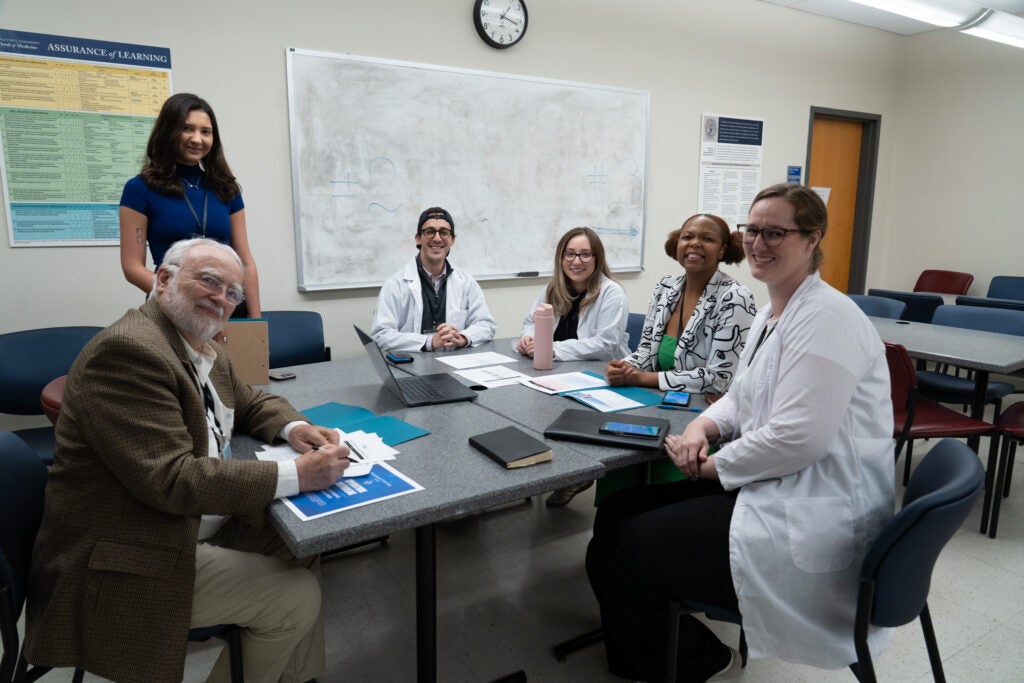
The scientific team works on developing a vaccine for the virtual pathogen. Photo courtesy of Operation Outbreak
On top of being a fun social experience for participants, the outbreak simulation importantly served as an innovative piece of immersive research.
“We can use [the outbreak] to understand human behavior and how humans move, because something we forget about outbreaks, and especially something that simulations teach us, is that humans are messy,” Hoffmann said. “There’s so many decisions we have to make. … What if you make a decision, then [the public] is firing back at you? For example, someone proposes a certain public health measure, and now the general population, who we simulated here, says, ‘I don’t want your medical countermeasure. I refuse to accept your medical countermeasure.’ Those are the types of things we want to study so that we can understand, as a whole system, how do we do this while an outbreak is happening so that we learn to minimize societal disruption?”
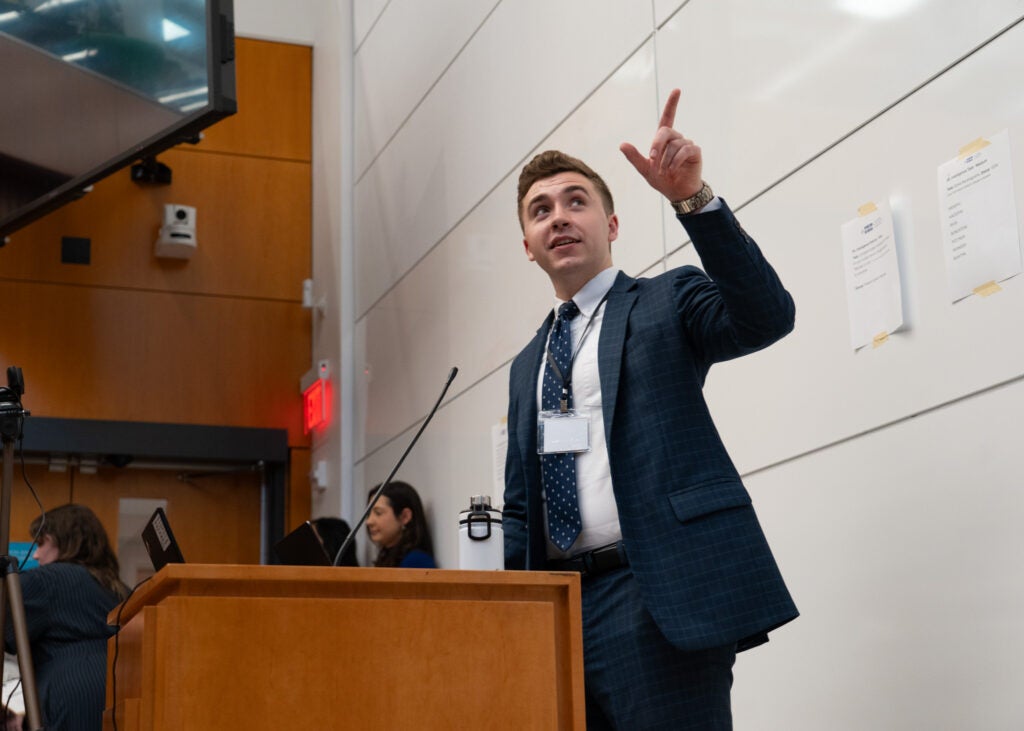
Hoffmann answers a question during the simulation. Photo courtesy of Operation Outbreak
Under the supervision of faculty advisors, Hoffmann will use this research for his capstone project in the Biohazardous Threat Agents & Emerging Infectious Diseases program.
One of his advisors was Julie Fischer, adjunct associate professor in the Department of Microbiology & Immunology. Fischer praised the simulation and pointed out the novelty of using the simulation app and subsequent data visualization as a pedagogical tool: “We will be thinking for some time about what we learned from this experience and how we can optimize the use of these tools, because it’s great when they’re developed, but how do we make them part of training, education, and practice?”
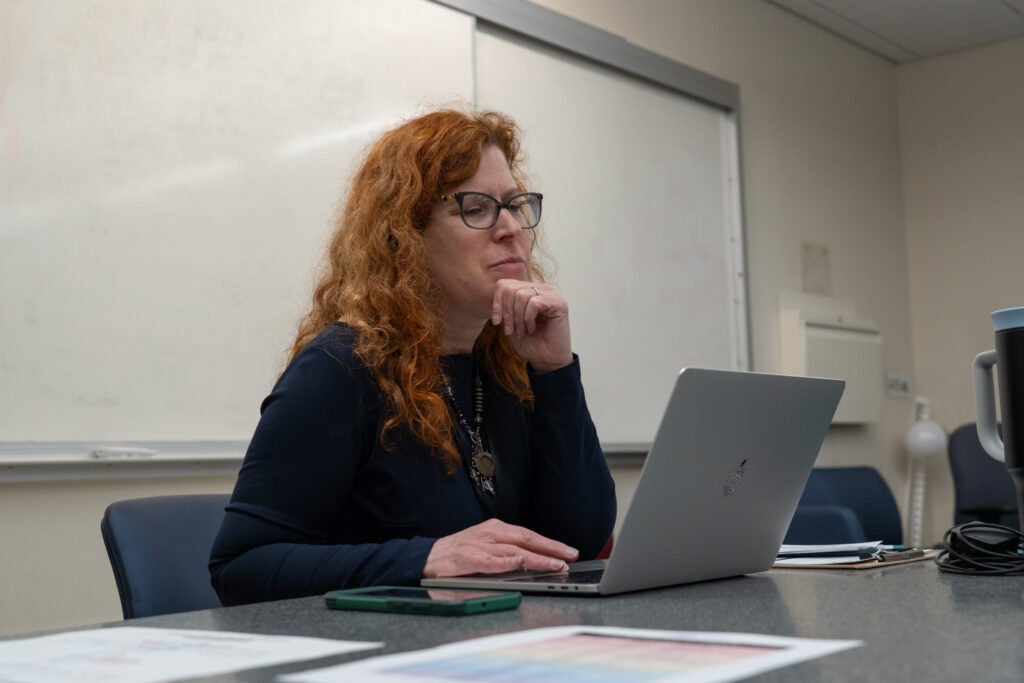
Adjunct Associate Professor Julie Fischer monitors the simulation. Photo courtesy of Operation Outbreak
Fischer said faculty are also “thinking about how we get students from the BHTA program and BGE to really do more with their capstone experiences than just write a paper – so, how do we get people to think about sharing what they’ve learned as part of a public event? How do we make this a holistic and integrated event where we have some students presenting their research, some students designing an exercise, some students collecting feedback from the exercise that will become part of their work, so there’s a lot of moving pieces. … I’m just really hoping that this is a pattern of something we can do more of … to [have] our students come in and build networks that let them showcase the work they’ve done and share the work they’ve done in a much more interactive and dynamic real-world [scenario]. Because in the real world, ideally, the work you’re doing doesn’t just go into a paper – it’s shared, there’s feedback, and you make network connections when you reach out to talk about your specific community, so that’s what the amazing part of this [research] was.”
Although the simulation is complete, the research goes on, as Hoffmann and many of his colleagues will continue to study the data collected in the months to come. Hoffmann is excited about the future of his research: “The program has been very supportive … to allow us to explore and design this project as a graduate research team. [They’ve] provided sources of funding, helped connect us with some amazing speakers so that we can make sure the event was as fruitful as possible, but Georgetown … and the faculty advisors, Dr. Tomoko Steen, Dr. Julie Fischer, and Dr. Jean-Paul Gonzalez have been immensely helpful …in how much they’re willing to entertain these ideas and say ‘You know what, you’re students, we’ll let you explore this, and we trust you that this is going to be great.’”
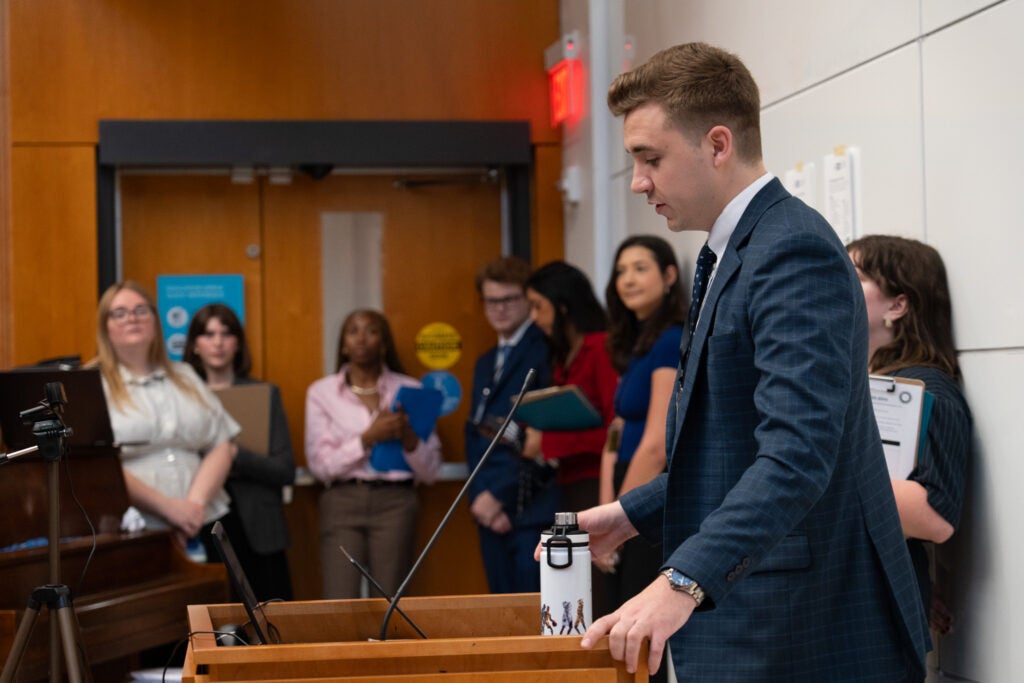
Hoffmann and the combined research team debrief after the simulation. Photo courtesy of Operation Outbreak
“I think that’s the great value that our BHTA program brings: Our classes are connecting with so many people from so many different fields, revealing the multidisciplinary nature of biosecurity. … I like to focus on outbreak science, the social side of infectious disease outbreaks and the human side of it, and [the program] has been tremendously helpful.”
Natalie Rabner contributed to this article.
Research Events at BGE
More BGE News
News
Graduate Students, Experts Gather for GU’s 14th Annual Nuclear Security Summit
Hosted annually since 2013 by Georgetown’s Biohazardous Threat Agents & Emerging Infectious Diseases (BHTA) program, the Nuclear Security Summit focuses on the risks and dangers of radiation, its impacts on space exploration and its effects on the planet. Graduate students and experts in attendance presented their research findings and shared key insights from their respective fields.
February 13, 2026
News
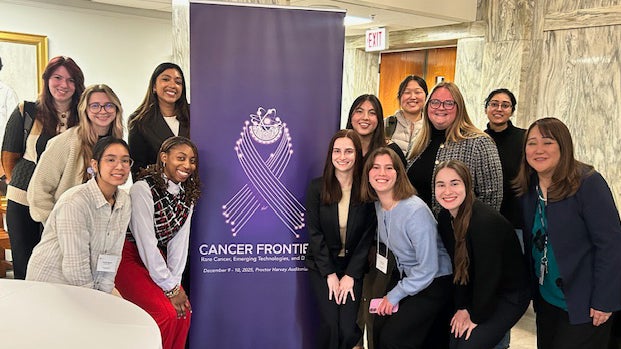
Cancer Frontiers Symposium Highlights Treatment Challenges, Emerging Technologies
Biomedical Graduate Education (BGE) faculty and students in December hosted a symposium focused on challenges and possibilities in cancer treatment. “Cancer Frontiers: Rare Cancer, Emerging Technologies, and Disparities,” held December 9-10, 2025, in the Medical and Dental Building, gave students a chance to learn from respected researchers and to present their own work.
January 28, 2026