
Inaugural Vicini Dissertation Award Winner Michel Fallah Seeks to Answer the ‘Why’s of Brain Disease
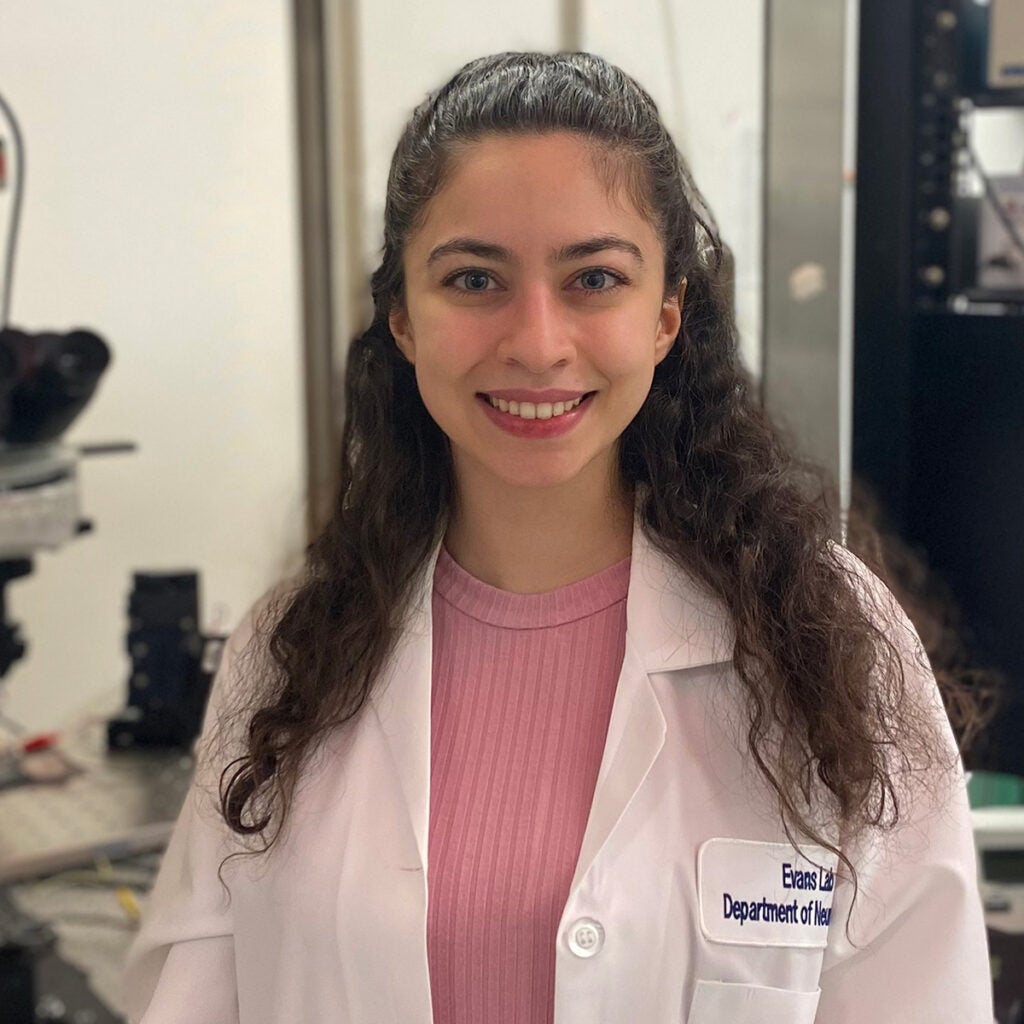
Michel Fallah
Michel Fallah (G’25, M’27), the inaugural recipient of BGE’s Stefano Vicini Dissertation Award, credits recently retired professor Stefano Vicini with helping her to find a focus in biomedical research: Using electrophysiology, the measurement of neurons’ electrical activity, to try to unravel the mysteries underlying neuropsychiatric and neurodegenerative conditions such as Parkinson’s disease.
It wasn’t the route she expected to take. “I did not like electrophysiology in medical school – at all,” said Fallah, an M.D./Ph.D. student who completed her Ph.D. studies in the Interdisciplinary Program in Neuroscience (IPN) in January 2025. While Fallah didn’t enjoy the subject, but she did admire the teacher, Vicini. (Vicini is not involved in choosing Vicini Dissertation Award winners.) When Fallah transitioned into her Ph.D. studies, she took a rotation in Vicini’s lab, working on confocal imaging of microglia motility in mice with APOE4 genotype, a strong risk factor for Alzheimer’s disease.
And then, “he told me that my personality and the way I approached problems would fit an electrophysiologist,” Fallah said. “I was like, ‘No, there’s no way.’ And he strongly pushed me to go work with Dr. Rebekah Evans, who was new at the time, so I would be her first Ph.D. student.”
Fallah was nervous to take the chance, but she took Vicini’s advice. And in Evans’ lab, electrophysiology clicked for her. Evans and Vicini would mentor Fallah through her dissertation, “Characterizing Regional Subpopulations Within the Pedunculopontine Nucleus and Their Interactions with Inhibitory Basal Ganglia Nuclei,” using the technology.
“I was extremely happy this worked out for me,” Fallah recalled. “I think I chose the best place to be. Everyone was so great to work with, and they just helped me figure out what I wanted to do.”
Laying the Groundwork for Future Treatments
Fallah’s dissertation research centered on the pedunculopontine nucleus (PPN), a region of the brain that communicates with the basal ganglia. The basal ganglia is involved in movement, and the area is known to be the critical point of failure in Parkinson’s disease, characterized by loss of control of body movements.
Fallah conducted experiments to determine how the PPN interacts with other, better understood parts of the basal ganglia, to help address the “huge question mark of how it fits” into movement and impairment.
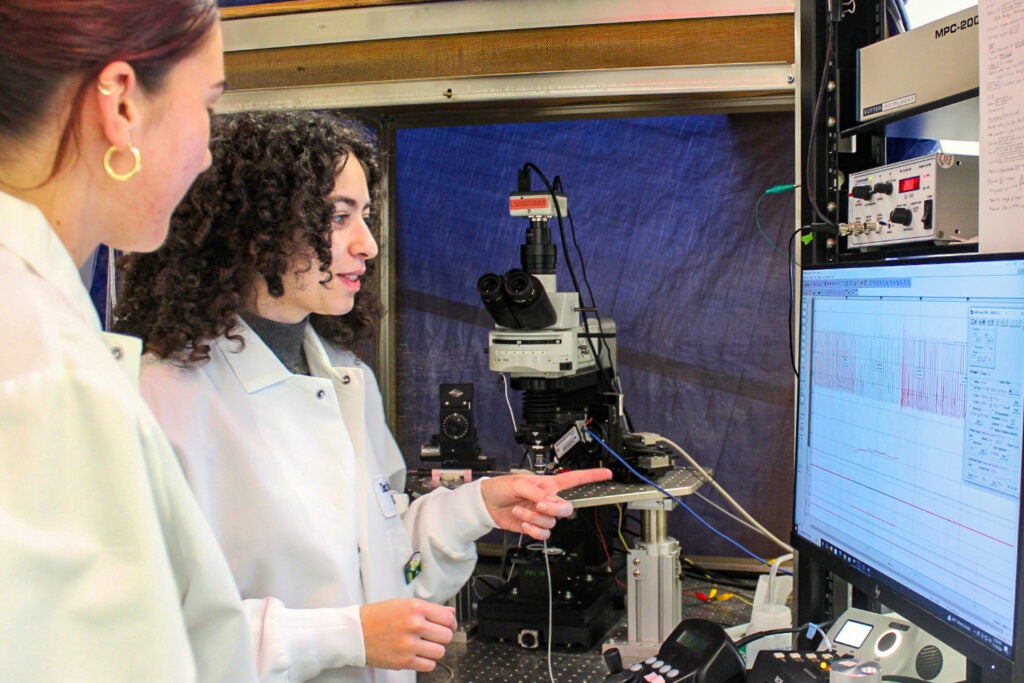
“What my work was starting to do is dissect that circuit, give us a general understanding as to how it interacts” with the major nuclei of the basal ganglia, Fallah said. If the PPN’s role in movement control pathways is better understood, it could be used as a target for future treatments for Parkinson’s.
For Fallah, understanding why disease happens is as compelling a question as how to treat it. As she looks ahead to finishing medical school in 2027, she hopes to secure a residency in psychiatry with a strong research element to keep pursuing the “why”s of disease.
“We truthfully don’t know how a lot of [mental health conditions] occur,” Fallah said. “And then when we think about approaching a treatment – I mean, how can you do that without knowing what underlies the disease? So that’s kind of what motivates me. I think I wouldn’t have been happy just doing psychiatry, for example, without putting in the work to pursue answers for us.”
Growing Impact
Fallah’s Ph.D. work wasn’t just in the lab. She attended conferences ranging from BGE’s on-campus Student Research Day, where she won first place for a poster presentation in 2021 and a talk in 2023, to larger events – the Society for Neuroscience, the NIH’s BRAIN Initiative Conference and the Basal Ganglia Gordon Research Conference.
“It’s amazing to share your work, show people what you’re working on – but I think going to the conferences, it really is more than that,” Fallah said. “It’s all that networking that you do, and the feedback that you can get from these people who are very experienced.”
She also put in work getting her research funded. In 2023, she received the National Institute of Neurological Disorders and Stroke (NINDS) Ruth L. Kirschstein National Research Service Award (F30) predoctoral fellowship. Fallah wrote in a student profile that year: “I see myself holding an academic position at a university like Georgetown one day. I would love to be a [principal investigator] with my own lab while still seeing patients a few days a week. The idea of treating patients but also being involved in the research that can improve their prospects is what motivates and drives me.”
Reflecting on her latest award, Fallah said: “It’s an honor to receive an award that is recognizing Dr. Stefano Vicini, who is obviously a great inspiration for me – not only as my co-mentor, but before that, even when I was just a medical student trying to figure out what I was going to do.”
She also values the recognition of her contribution to the effort to discover how Parkinson’s happens, and how the disease might be stopped.
“It’s a year out, and the idea that people are still thinking about the work I did – you know, that was three to four years of hard work, a lot of hours in the lab,” Fallah said. “I appreciated that people see the value in the research, the rigorous science that I was trying to produce. … If people are still talking about it, that means that they see that it is another step closer to finding answers.”
I am so proud of Michel! As the first Ph.D. student in my lab, she was a real leader and set the tone of scientific excellence and collaboration. She really deserves this award.
Rebekah Evans, Assistant Professor, Department of Neuroscience
I worked with Michel during her rotation in my lab on motility of microglia and their response to ATP. It was during COVID and a very tense time. She brought organization to the experimental sequences and insights on the results that were useful to several students that came after her. But most of all, it was really fun to work together and share the excitement of seeing the brain come alive. She will become a gifted physician-scientist.
Stefano Vicini, Professor Emeritus, Department of Pharmacology & Physiology
Awards and Funding for BGE Researchers
More BGE News
Faculty, News
Dissertation Award for BGE Students Will Honor Longtime Professor Stefano Vicini
The inaugural Stefano Vicini Dissertation Award will be presented in May 2026. Vicini, who retired in summer 2025, has been a Georgetown faculty member for 40 years and has mentored dozens of Ph.D. students.
December 19, 2025
External Fellowship & Award Recipients, News, Student Profiles
Students from across Georgetown doctoral programs speak about their research, their studies, and how NIH-funded T32 and TL1 programs are helping them to reach their career goals.
April 10, 2025